Article: THE GREAT WALLPAPER DEBATE: PEEL & STICK WALLPAPER VS TRADITIONAL UNPASTED WALLPAPER – WHICH ONE REIGNS SUPREME!
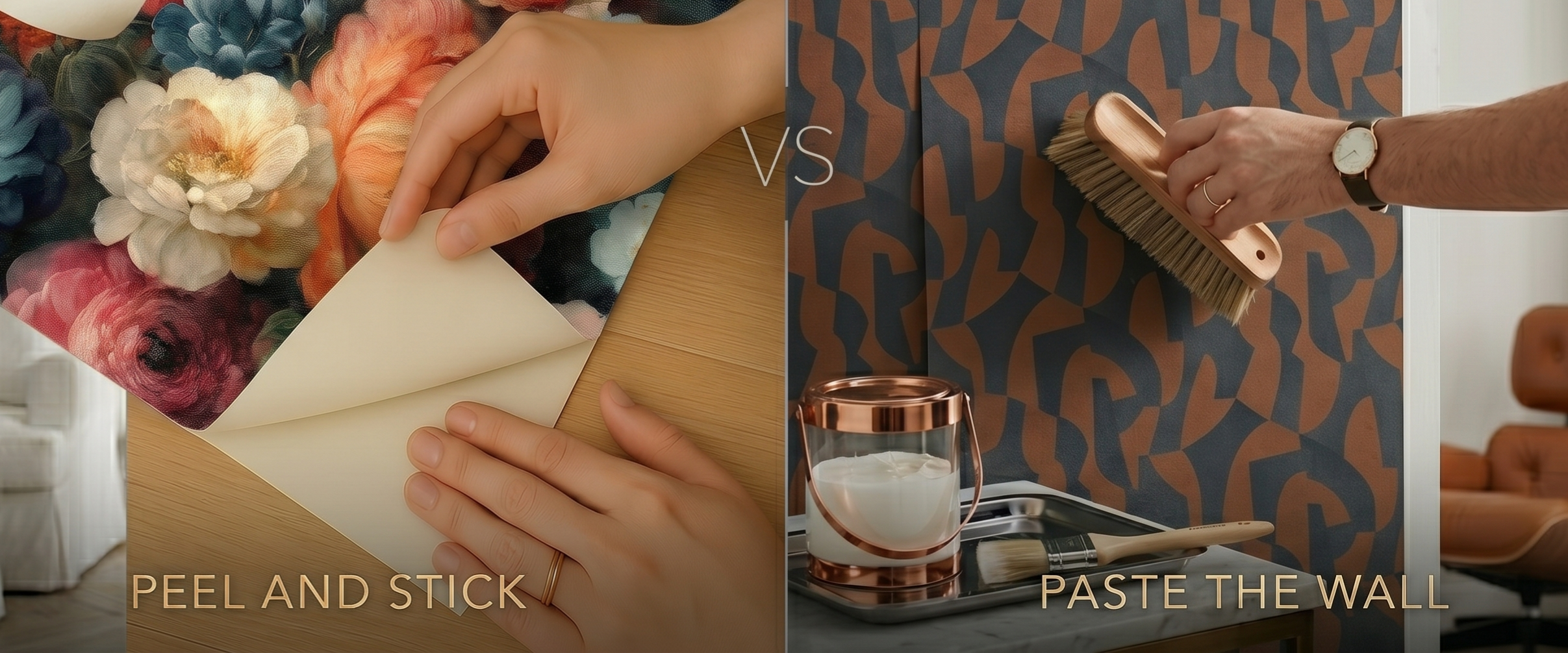
THE GREAT WALLPAPER DEBATE: PEEL & STICK WALLPAPER VS TRADITIONAL UNPASTED WALLPAPER – WHICH ONE REIGNS SUPREME!

Today, the debate between peel-and-stick and non-woven paste-the-wall wallpaper has become one of the biggest conversations in interior design. While each offers its own unique benefits, the two mediums are fundamentally different. In the end, though… could there be a clear winner?
“I wouldn’t bring hot dogs to have dinner with King Charles,” laughs PJ Delaye, founder of Veer Décor, the rising US wallpaper manufacturer and distributor. “That said, I do enjoy a great hot dog! I guess what I’m trying to say is that there’s a time and place for everything. Different occasions call for different attitudes—and that is very much the case for wallpaper.”
Delaye certainly doesn’t hate peel-and-stick wallpaper. “It absolutely contributed to bringing wallpaper back into the zeitgeist in the US,” he notes.
Indeed, consumers fell head over heels for the promise of an easier, totally non-committal design experience. Because wallpaper had almost entirely disappeared from the average consumer's mindset (even though it remained a staple in the high-end design community), a whole new generation experienced wallpaper for the first time through peel-and-stick.
Because they had never hung wallpaper before, they had no baseline. They found it “easy enough!”
It’s also worth remembering that throughout the ’90s and early 2000s, wallpaper was only mentioned on home design shows when it was time to “get rid of that ugly wallpaper.” An entire generation was raised on a steady diet of long, arduous, patience-testing wallpaper removal segments that usually ended with a frustrated homeowner swearing, “Never again.”
Fast Fashion for the Walls: Why Peel and Stick Became So Popular
You can imagine how revolutionary it was to be promised wallpaper that could be removed in full strips in mere seconds. The ultra-removability of peel-and-stick addressed the consumer’s #1 fear: long-term commitment.
Suddenly, wallpaper was no longer a "forever" decision. For an audience accustomed to fast fashion ("I'll only wear this for one season!"), peel-and-stick pushed all the right buttons. It became fast fashion for your walls.

Veer Décor Moody Floral Peel & Stick Wallpaper - VRPS001-01
Beyond walls, it also proved fantastic for quick, fun “restore and restyle” DIY projects on tired surfaces—think old armoires, bookshelves, or decorative trays. (Before peel-and-stick, these projects were doomed to the realm of ugly, permanent self-adhesive contact paper).

Veer Décor Medina Trellis Peel and Stick Wallpaper 8228-AO3
Is Peel and Stick Wallpaper Actually Easier? Answer: It’s All About The "Slippage"!
Despite its perks, there is one thing PJ Delaye will maintain until he’s blue in the face: While peel-and-stick absolutely serves a purpose (heck, Veer Décor just launched a curated line of neat peel-and-stick designs), it is NOT easier to install than traditional paper.
Ask any professional wallpaper installer. Most frown upon the stuff; some categorically refuse to hang it.
So, what drives these pros to boycott peel-and-stick? Pure snobbery? Fear of losing jobs to DIYers?
Nope. It’s the lack of “slippage.”
Come again? Yes, slippage. It’s that magical maneuverability you only get from the wetness of real wallpaper paste.
Hanging wallpaper usually requires you to match a pattern perfectly from one strip to the next. Peel-and-stick bonds instantly upon contact with the wall. That means your side-to-side pattern match has to be flawless the exact millisecond the paper touches the wall. While the best peel-and-stick brands claim easy repositionability, getting that design perfectly aligned remains incredibly frustrating. It turns a simple task into a two-person job: one person to guide the alignment, and another to hold the rest of the sticky strip away from the wall so it doesn't accidentally grab on – or stick to itself.
With traditional wallpaper (which Delaye and design experts lovingly call “real wallpaper”), the viscosity of the paste allows the strip to glide and slide right on the wall. You can effortlessly nudge the pattern into perfect alignment. Just like that, you're back to an easy, one-person job.

Enter the Non-Woven Revolution – and Why Designers and Installers Prefer These “Paste-The-Wall” Wallpapers
Here is the kicker: non-woven "paste-the-wall" wallpaper isn't even new. It’s been around for over 20 years.
First, no one talked about it stateside because no one was talking about wallpaper period. Then, when accent walls made a comeback, peel-and-stick hogged the spotlight as the new miracle product. But outside the US, virtually all premium manufacturers recognized the superior properties of non-woven substrates:
- Ultimate Stability: It doesn’t expand or contract like standard paper. Because it's dimensionally stable, it prevents those unsightly, gapping seams from forming over time.
- No "Booking" Required: Because it doesn't stretch or shrink when wet, you don't need to fold the paper onto itself to let it "relax" before hanging.
- Roll the Wall, Not the Paper: You simply apply paste directly to the wall using a standard paint roller. It’s as easy as painting! Then, you apply your dry strip of paper directly to the pasted wall.
- Easy, Clean Removal: Non-woven material is exceptionally strong. When it's time for a change, you just pick the top two corners and pull down. It removes in full, clean strips—just like peel-and-stick!

What About Prepasted Wallpapers?
Doesn’t prepasted paper offer the best of both worlds—no paste required, but you still get slippage? Technically, yes. But prepasted paper requires you to soak the strips in a special water tray, resulting in a drippy, sloppy mess. Unsurprisingly, manufacturers are phasing prepasted options out.

Years ago, the rest of the world shifted to unpasted, non-woven wallpaper, embracing "paste-the-wall" as the superior installation technique. Many US companies offer it too, but they've done a poor job educating consumers on its perks. PJ and Veer Décor are claiming the mantle of North American Paste-the-Wall Crusaders, aiming to show DIYers and designers alike a better way to hang.

Non-woven backings also allow manufacturers to push design boundaries. While printing on peel-and-stick vinyl is technically limited, non-woven substrates allow for rich, deep-embossed textures, tactile surfaces, and eco-friendly PVC-free materials. Better printing techniques mean infinitely better designs.
Ex
Example of deep in-register emboss providing a fabric-like relief to the wallpaper. Veer Décor Geometric Trellis 8387-AJ3
Where Do We Stand Today?
1. The Peel-and-Stick Pushback
While still wildly popular at mass and big-box retailers, the industry is seeing a bit of peel-and-stick fatigue:
- Professional hangers still prefer to avoid it.
- DIYers who graduate to higher-end projects are realizing it’s trickier to install perfectly than social media makes it look.
- The market has been flooded with cheap, low-quality knockoffs. Many are just shelf-liner companies masquerading as wallpaper brands. Use the wrong brand, and you either get ultra-aggressive adhesive (leaving behind sticky globs or ripped drywall) or weak adhesive (resulting in bubbling paper that eventually falls down). Some cheap rolls don't even feature matching side-to-side patterns!

Example of a damaged dry wall after removal of a cheap peel and stick wallpaper with a too aggressive adhesive.
"Peel-and-stick is somewhat unique to the US market, so stick to reputable US or Western European brands that specialize specifically in wallpaper," advises Delaye.
2. The Wallpaper Renaissance
Wallpaper is officially back as a powerhouse in interior design. Look at hit shows like Only Murders in the Building or The White Lotus, where bold wallpaper is used so purposefully it practically acts as a supporting character.
As consumers become more educated, they want a premium finish. Many used peel-and-stick as a gateway drug to get back into pattern and color. Now, they're ready for a more polished, high-end option. Delaye and industry pros are ready to welcome them to the world of non-woven paper.

Veer Décor Bird of Paradise 8387-AA3
The Price Tag Illusion: Which is Actually More Affordable and What is The Best Wallpaper Type for Your Budget?
When it comes to cost, there are countless variables to consider since not all wallpapers are created equal. That said, the idea that peel-and-stick is always the cheaper option is one of the industry's biggest myths.
First, beware of ultra-cheap peel-and-stick sold on generic “everything and anything” online marketplaces. These bargain rolls are usually just cheap liner paper slapped with the wrong type of adhesive. To make matters worse, the patterns are rarely scaled or formatted for full-wall applications. In the end, you're buying glorified craft paper, not real wallpaper! (Pro tip: Keep an eye on the width. Anything under 18 inches wide is a dead giveaway that it’s shelf liner masquerading as decor).
Second, you have to look at the math. Many peel-and-stick rolls are sold in short 16.5-foot or 18-foot strips. Meanwhile, a standard unpasted wallpaper roll gives you roughly 27 to 33 feet of length. Widths vary wildly too—standard residential rolls usually sit between 20.5 and 27 inches wide, while luxury options like grasscloth and natural fibers stretch to 36 inches or more. To get a genuine understanding of the price difference, you have to break it down to a cost-per-square-foot calculation. Once you compare the actual coverage you're getting, you might be shocked to see just how competitively priced premium "paste-the-wall" paper really is!
The Final Takeaway
We all owe peel-and-stick a debt of gratitude for reintroducing North America to the joy of wallpaper. It remains the undisputed champion for renters (thanks to its landlord-approved removal) and crafty weekend DIYers.
But when it comes to elevated, seamless home decorating... nothing beats real wallpaper. And in that arena, unpasted non-woven wallpaper reigns supreme.

Quick Recap: Peel-and-Stick vs. Non-Woven Wallpaper
Use this cheat sheet to figure out which option is the perfect match for your next project!
|
Feature |
Peel-and-Stick Wallpaper |
Non-Woven (Paste-the-Wall) |
|
Installation Method |
Peel off backing, apply directly to wall. |
Roll paste onto the wall, apply dry paper. |
|
"Slippage" (Adjustability) |
None. Sticks instantly; hard to adjust. |
High. Paste allows easy sliding for perfect seams. |
|
Labor |
Often a 2-person job to align patterns perfectly. |
Easily a 1-person job. |
|
Removal |
Pulls off in full strips instantly. |
Pulls off in full strips instantly |
|
Ideal User |
Renters, dorm rooms, small craft projects. |
Homeowners, interior designers, long-term DIYers. |
|
Design Variety |
Limited textures; mostly flat vinyl (although non-PVC offering is starting to appear). |
Rich textures, deep embossing, greater variety of complex constructions and eco-friendly options. |
|
The Verdict |
Best for quick fixes and temporary "fast fashion." |
Best for premium aesthetic and stress-free alignment. |
And if this wasn’t enough, here is one final, ultimate F.A.Q. on the subject:
● Is paste-the-wall wallpaper removable? Yes – non-woven wallpapers are stronger than their paper counterparts of yesteryears and they will remove in full strips. We would always recommend using priming and sizing your walls for an even greater and easier removal.
● Is peel-and-stick wallpaper easier to install? Sorry! That’s a definite “No”! Peel and stick wallpaper adheres immediately to the wall on contact, making it hard to perfectly align the design from one strip to the next. Paste-the-wall, non-woven wallpapers effortlessly slide into position, making the side-to-side pattern match a breeze.
● What wallpaper do professional installers prefer? Categorically non-woven backed wallpapers. Not even close! Some even refuse to hang peel and stick.
● What is non-woven wallpaper? Non-woven wallpaper is a modern wallpaper material made from a blend of natural and synthetic fibers bonded together to create a durable, breathable, and dimensionally stable wallcovering. Unlike traditional paper wallpaper, non-woven wallpaper does not expand significantly when wet or contract as it dries, making installation cleaner and more precise. Most non-woven wallpapers are installed using the “paste-the-wall” method, where adhesive is applied directly to the wall rather than the back of the wallpaper itself. This makes the material easier to handle, reposition, and align during installation.
● Does peel-and-stick wallpaper damage walls? Cheap peel and stick wallpapers can absolutely destroy your dry wall if made with an adhesive not specifically engineered for walls. A poor adhesive runs the risk of fusing your wallpaper to the surface overtime, hence damaging your walls upon removal.
● What is the best wallpaper type for homeowners? Paste-the-wall non-woven wallpapers is considered best for homeowners while peel and stick wallpapers remain a great solution for renters.
For more insights on the business and practical side of modern wall coverings directly from PJ Delaye, check out this interview: PJ Delaye Discussing Wall Covering Industry Trends. This discussion dives deep into why non-woven backings have taken over as the quality standard and how they truly compare to peel-and-stick options.